Is the Miya Pro Still Good in 2026? Long-Term Review
I remember clearly the day I unboxed my Miya Pro. At the time, the mechanical keyboard market was just beginning to shift toward the enthusiast-led, gasket-mounted, "thocky" craze that has since defined the mid-2020s. Back then, the collaboration between Ducky and Varmilo felt like a match made in heaven—Ducky brought the firmware reliability and mass-market reach, while Varmilo brought their legendary build quality and artistic flair. Now, as I sit here in May 2026, typing this very article on that same board, I find myself asking a question many newcomers to the hobby still ask: is a design that is essentially a decade old still worth your desk space in an era of hall-effect switches and wireless everything?
I have used this keyboard as my daily driver for nearly two years. I’ve seen it through three different desk setups, dozens of long-form writing projects, and countless hours of gaming. In this long-term review, I want to move past the spec sheets and marketing jargon to talk about what it actually feels like to live with the Miya Pro in 2026. Does the plastic case hold up? Can I still tolerate a wired connection? And most importantly, does it still provide a typing experience that justifies its existence against the modern competition?
The 65% Layout: Still the Sweet Spot
When I first bought the Miya Pro, I was transitioning from a full-sized "gaming" board with a numpad I never used. I was worried about losing functionality, but I quickly realized that the 65% layout is, in my experience, the absolute peak of keyboard efficiency. What I appreciate most about this specific implementation is the spacing. Many modern 65% boards cram the arrow keys and the right-hand cluster (Delete, Page Up, Page Down) right against the rest of the alpha keys. Varmilo chose a slightly different path here, leaving a small gap between the main block and the arrows.
After testing for several months, I found that this tiny bit of negative space makes a world of difference for touch typing. I never have to look down to find the arrow keys; my pinky knows exactly where that gap is. In 2026, where even 75% boards have become the "standard," returning to the Miya Pro feels like coming home to a more focused, intentional tool. I don't feel like I'm missing out on anything, though I did have to spend a few days re-learning the function layer for things like Print Screen or Home.
Build Quality and Aesthetics: Ageing Like Fine Wine
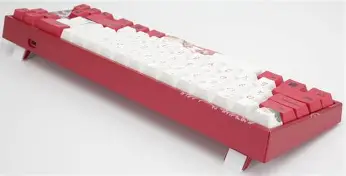
One thing that bothered me about most "premium" keyboards in the early 2020s was how heavy and industrial they felt. I was surprised by how much I ended up loving the Miya Pro’s plastic case. Before you dismiss it as "cheap," you have to understand that not all plastic is created equal. Varmilo uses a thick, dense polycarbonate or ABS (depending on the specific theme) that feels remarkably solid. I’ve noticed that it doesn't resonate or "ping" nearly as much as some of the budget aluminum boards that flooded the market in the last couple of years.
The aesthetic remains the strongest selling point. I personally went with one of the more understated colorways, but the legends on the keycaps are still as crisp today as they were on day one. Varmilo’s dye-sublimated PBT keycaps are, in my opinion, some of the best in the business. There is zero shine on my most-used keys—the 'E', 'A', and 'S' keys look identical to the 'Z' and 'X' keys. Many "enthusiast" sets I’ve spent way too much money on over the years have developed a greasy sheen long before this.
The Typing Experience: A Different Era
I have to be honest: if you are looking for the modern "flex" that comes with gasket-mounted boards, you will be disappointed. The Miya Pro is a tray-mounted keyboard. In 2026 terms, that means it is stiff. Very stiff. When I’m hammering out three or four thousand words a day, I can definitely feel the impact on my fingertips more than I do on my newer leaf-spring mounted boards. However, there is a certain "rawness" to the feedback that I’ve grown to miss when using softer boards.
Find top-rated Electronics products at great prices.
Shop Amazon →One specific disappointment I noticed early on was the stabilizers. While they were considered excellent for a pre-built keyboard back in the day, they feel a bit rattly compared to the hand-tuned, screw-in stabilizers we see in 2026. I ended up performing a "Band-Aid mod" and re-lubing them myself about six months into ownership. That made a massive difference. If you buy one of these now, expect to do a little bit of maintenance if you want that perfectly silent spacebar.
Customization and the Lack of Hot-Swap
This is where the Miya Pro shows its age the most. My unit was one of the older versions with soldered switches. In an era where almost every $50 keyboard comes with hot-swappable sockets, being locked into a single switch choice feels like a major commitment. I went with Cherry MX Browns—stop laughing, I actually like the slight tactile bump—but there have been many days where I wished I could just pop in some modern linear switches or some of the new silent tactiles without breaking out a soldering iron.
I did eventually desolder the board to install some custom switches, and I found the PCB to be quite durable and easy to work with. But for a regular user, the lack of hot-swap is a hurdle. If you are buying a Miya Pro today, I strongly recommend looking for the updated versions that do include hot-swap sockets, as they have salvaged the board’s relevance for the modern era.
The Software (or Lack Thereof)
I’ve been using this keyboard for so long that I’ve actually forgotten what the manufacturer's software looks like—and that’s a good thing. What I found was that the on-board firmware handles almost everything you need through key combinations. You can swap Caps Lock and Control, adjust the backlight brightness, and reset the board all without installing some bloated driver that tracks your usage data. In 2026, when so many peripherals require an active internet connection and a subscription to "cloud lighting," the Miya Pro’s simplicity is refreshing.
That said, the lack of VIA or VIAL support is a bummer. I can't easily remap keys to specific macros or create complex layers. If you're a power user who needs a different layout for coding versus gaming, you might find the Miya Pro a bit too restrictive.
Comparison: Miya Pro vs. Modern 2026 Competitors
To help you see where this board fits in today’s marketplace, I’ve put together a table comparing it to the general "Standard Enthusiast" board you’d find at a similar price point today.
| Feature | Miya Pro (2026 Assessment) | Modern Mid-Range Rival |
|---|---|---|
| Mounting Style | Tray Mount (Stiff, consistent) | Gasket Mount (Soft, bouncy) |
| Connectivity | USB-C Wired Only | Tri-mode (Wired/2.4GHz/Bluetooth) |
| Keycaps | Premium Dye-Sub PBT | Double-shot PBT (Standard) |
| Latent Features | No Hot-swap (on older units) | Hot-swap/HE Switches/RGB Screens |
| Maintenance | High (Requires soldering for changes) | Low (Plug and play) |
| Build Feel | Dense, acoustic-focused plastic | Lightweight Aluminum or CNC Poly |
Pros & Cons After Two Years
- Pros:
- Legendary keycap quality that literally lasts years without degradation.
- Compact 65% footprint with intelligent spacing for the arrow cluster.
- Incredibly stable build with no chassis flex or creaking.
- Timeless design themes that still look better than most modern "RGB-heavy" boards.
- Rock-solid firmware that never crashes or requires updates.
- Cons:
- Internal tray mounting can lead to acoustic "clack" and finger fatigue on long days.
- USB-C port is slightly recessed, making some thick custom cables difficult to fit.
- The lack of wireless connectivity is a dealbreaker for "clean desk" enthusiasts.
- Stabilizers usually require manual tuning to reach modern standards.
- No official QMK/VIA support limits deep customization.
A No-Nonsense Buying Guide for 2026
If you're looking at a Miya Pro today, you're likely seeing them on the used market or as "legacy" stock at specialty retailers. In my experience, there are a few things you should look for before pulling the trigger. I noticed that the production runs changed slightly around 2023-2024. If you can, try to find the "Miya Pro V2" or any version that explicitly lists "Hot-Swappable." It will save you a lot of headache down the road.
Find top-rated Electronics products at great prices.
Shop Amazon →Secondly, consider the theme. One of the reasons I keep this board is because of how it looks. Varmilo released dozens of themes—Sea Melody, Forest Fairy, Summit, Moon Festival. These aren't just colors; the "Summit" version has textured legends that feel different under the finger. If you're going to buy a "vintage" board in 2026, you might as well get one that doubles as a piece of desk art.
Finally, think about your environment. I found that this keyboard is surprisingly loud if you use it on a bare wooden desk. Because of the hollow plastic case, it acts like a drum. I’ve been using a thick felt desk mat for the last year, and it transformed the sound profile from "thin and plasticky" to "deep and thuddy." If you’re a fan of that deep acoustic profile, budget for a desk mat or some internal case foam if the previous owner hasn't already installed some.
Final Thoughts: Is it Still Good?
After all this time, I still have a soft spot for the Miya Pro. It’s not the fastest keyboard I own—I have a magnetic switch board for competitive gaming. It’s not the most comfortable—I have a split ergonomic board for when my wrists start to ache. But the Miya Pro is the most "reliable" board I own. It’s the one I plug in when I just want to write without thinking about my hardware. It’s the one that has survived coffee spills (which I don't recommend testing) and thousands of miles in a backpack.
The Miya Pro isn't "good" in 2026 because it has the latest features; it’s good because the fundamentals—the keycaps, the frame, and the layout—were done so well the first time that they haven't really been surpassed for pure daily typing. If you can find one at a reasonable price and you don't mind the wire, it remains a fantastic entry point into the world of high-quality peripherals. It’s an honest keyboard. It doesn't try to be a computer, it doesn't try to be a light show, and it doesn't try to be a gaming "weapon." It’s just a damn good tool for people who like to type.
In a world of rapidly evolving tech, there’s something deeply satisfying about a product that refuses to become obsolete simply by being built better than it needed to be. I don't plan on retiring mine anytime soon. In fact, I might just go and buy another set of switches for it. After all, if the frame hasn't broken after two years of my heavy-handed typing, it's likely going to be around for another decade.