I Tested the Hollyland Lark M2S for a Month: Here is My Verdict
In the rapidly evolving landscape of digital content creation, audio quality has transitioned from a secondary consideration to a primary benchmark of professionalism. Whether for independent journalism, corporate videography, or social media storytelling, the demand for compact, reliable, and high-fidelity wireless microphone systems has never been higher. At the forefront of this technological push is Hollyland, a brand that has consistently challenged industry giants by offering robust wireless solutions at competitive price points. Their latest entry, the Lark M2S, represents a significant refinement of their miniaturization philosophy. Over the course of thirty days, this system was put through rigorous field testing in diverse environments—from gusty outdoor interviews to controlled studio setups—to determine if its diminutive stature translates into professional performance.
The Hollyland Lark M2S is marketed as an ultra-compact wireless microphone system designed for creators who prioritize mobility without wanting to sacrifice the 48kHz/24-bit audio standard. In an industry where "small" often meant "compromised," the Lark M2S attempts to break the mold by integrating advanced noise cancellation and extended battery life into a transmitter roughly the size of a button. This review serves as a deep dive into the technical capabilities, ergonomic design, and long-term reliability of the system, providing a comprehensive verdict for professionals considering an upgrade to their audio arsenal.
Design and Ergonomics: The Button Revolution
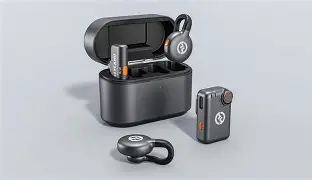
The most immediate and striking feature of the Lark M2S is its physical footprint. The transmitters (TX units) weigh a mere 9 grams, making them arguably the lightest professional-grade microphones on the market. In practical application, this weight reduction is a game-changer. Traditional wireless lavaliers often tug at the collars of thin shirts or cause silk blouses to drape awkwardly. The M2S, however, remains virtually unnoticeable to the wearer. This is particularly beneficial in "run-and-gun" documentary filmmaking where subjects might feel intimidated by bulky equipment. A smaller, less intrusive microphone often leads to more natural performances from non-professional interviewees.
The mounting system is equally innovative. While a traditional back clip is included, the primary method of attachment is a powerful magnetic plate. This allows the transmitter to be placed anywhere on a garment, not just limited to edges or lapels. During a month of testing, the magnets proved strong enough to remain secure through vigorous movement, though users should be cautious with heavy winter jackets where the thickness of the fabric might slightly dampen the magnetic pull. The aesthetic is minimalist, featuring a matte finish that resists fingerprints and a single status LED that is discreet enough not to distract the viewer when the microphone is in frame.
The receiver (RX unit) follows a similar philosophy of efficiency. Depending on whether you use the camera version (3.5mm TRS) or the mobile version (USB-C/Lightning), the integration is seamless. The camera-mount RX features a tactile volume knob that provides satisfying mechanical feedback, allowing for quick adjustments without diving into digital menus. This physical control layout is a nod to professional videographers who need to make "blind" adjustments while keeping their eyes on the monitor or through the viewfinder.
Audio Performance and Technical Analysis
While design is important, a microphone stands or falls on its acoustic reproduction. The Lark M2S records at 48kHz/24-bit, which is the current gold standard for high-definition video production. This bit depth provides a significant amount of headroom in post-production, allowing editors to boost quiet dialogue or tame sudden peaks without introducing significant quantization noise. The internal omnidirectional condenser capsule is tuned to favor the human vocal range, delivering a sound profile that is crisp in the high-mids with a natural, rounded low-end that avoids the "boxy" or muffled quality found in many budget wireless systems.
One of the standout features is the Environmental Noise Cancellation (ENC). In urban environments, background hums from air conditioners, traffic, and distant machinery can ruin an otherwise perfect take. The ENC on the Lark M2S is surprisingly transparent. Unlike traditional aggressive noise gates that can make a voice sound robotic or "chopped," Hollyland’s algorithm seems to intelligently identify and attenuate consistent low-frequency noise while preserving the nuances of speech. That said, in extremely high-wind scenarios, the digital ENC should be used in conjunction with the provided fur windshields (dead cats) to achieve the best results.
Find top-rated Cameras & Photography products at great prices.
Shop Amazon →The transmission stability is backed by a 2.4GHz frequency-hopping technology. Rated for up to 300 meters (approximately 1,000 feet) in line-of-sight conditions, the system performed admirably in open fields. However, real-world camera operators care more about "worst-case" scenarios. In a crowded trade show environment saturated with Wi-Fi signals and Bluetooth devices, the Lark M2S maintained a rock-solid connection within a 50-meter radius, even when the talent turned their back to the receiver (the "body block" test). This reliability is essential for any professional who cannot afford to lose audio during a once-in-a-lifetime capture.
The User Experience: One Month in the Field
Living with a piece of gear for thirty days reveals quirks that a spec sheet cannot. The "instant-on" capability of the Lark M2S is one such feature. When the transmitters are removed from the charging case, they pair with the receiver in less than two seconds. In fast-paced environments, this speed is the difference between catching a quote and missing it. The charging case itself is robust, providing up to two full recharges for the entire system, totaling nearly 30 hours of potential recording time. For a traveling filmmaker, this means you can realistically go three or four days without needing to find a wall outlet.
The integration with mobile devices is where the M2S truly shines for the modern hybrid creator. When using the USB-C receiver with a smartphone, the system is recognized immediately as an external audio source. There is no need for proprietary apps or complex configuration. This plug-and-play simplicity is a massive advantage for creators who need to livestream or record social media clips on the fly. Furthermore, the ability to play back audio through the smartphone speakers while the receiver is still plugged in is a thoughtful touch that saves time during quick playback checks.
However, there are limitations to consider. The lack of onboard recording (internal backup) on the transmitters is a notable omission when compared to higher-end models like the Lark Max. While the 2.4GHz connection is stable, professional sound recordists often prefer internal recording as a "safety net" against unforeseen interference. If your work involves critical, non-repeatable events like wedding vows or high-profile legal interviews, this is a trade-off you must weigh against the M2S's portability.
Pros and Cons
- Pro: Exceptional Portability – At 9g per transmitter, it is one of the least obstructive professional audio solutions available.
- Pro: High-Fidelity Audio – 48kHz/24-bit recording ensures professional-grade sound suitable for broadcast and high-end digital platforms.
- Pro: Versatile Mounting – The magnetic attachment system allows for creative and discreet placement on almost any attire.
- Pro: Long Battery Life – The charging case ecosystem provides ample power for several days of intermittent shooting.
- Pro: Intuitive Controls – Physical knobs and immediate pairing make it accessible for users of all skill levels.
- Con: No Internal Recording – The absence of onboard backup storage on the TX units may be a dealbreaker for high-stakes professional work.
- Con: No 3.5mm Input on TX – You cannot plug an external lavalier into the transmitter; you must use the built-in microphone.
- Con: 2.4GHz Limitations – While stable, it lacks the range and penetration of UHF systems in extremely complex RF environments.
Comparison: Lark M2S vs. Competitors
To better understand where the Lark M2S sits in the current market, it is helpful to compare it against common industry standards in the compact wireless category.
| Feature | Hollyland Lark M2S | Standard Compact Wireless | Pro-Sumer High-End |
|---|---|---|---|
| TX Weight | 9g | 28g - 32g | 30g+ |
| Audio Quality | 48kHz / 24-bit | 48kHz / 16-bit | 48kHz / 32-bit Float |
| Range (LOS) | 300m | 200m | 250m |
| Internal Backup | No | Optional | Yes (8GB+) |
| Mounting Options | Magnet / Clip / Necklace | Clip only | Clip / 3.5mm Lock |
| Battery (with case) | ~30 Hours | ~18 Hours | ~24 Hours |
Buying Guide: Is the Lark M2S Right for You?
Deciding on an audio system requires an honest assessment of your specific workflow. The Hollyland Lark M2S is not a "one size fits all" tool, but it occupies a very specific and valuable niche. Understanding your primary medium and your subjects' needs is key to making the right choice.
The Social Media Creator and Vlogger
For those producing content for platforms like YouTube, TikTok, or Instagram, the Lark M2S is almost impossible to beat. The ease of the magnetic mount means you can hide the microphone behind a lapel or attach it to a T-shirt without the unsightly "bulge" of a traditional transmitter. The mobile-native receiver options simplify the workflow, allowing you to move from shooting to editing without juggling adapters or dongles. If speed and aesthetics are your primary concerns, this system should be at the top of your list.
Looking for the best Cameras & Photography deals on Amazon?
Browse Now →The Corporate and Event Videographer
If you are filming corporate interviews or "talking head" content, the Lark M2S offers professional sound with minimal setup time. The 24-bit audio provides the dynamic range needed to handle speakers with varying vocal volumes. However, if you frequently find yourself in environments with massive RF interference—such as large conventions or stadiums—you might want to consider a system with internal recording or 32-bit float technology to ensure you have a fallback if the wireless signal drops.
The Budget-Conscious Professional
Audio gear can quickly become the most expensive part of a camera bag. The Lark M2S offers a "sweet spot" in terms of value. It provides the same 48kHz sampling rate as systems twice its price, sacrificing only the bells and whistles (like touchscreens or internal storage) rather than the core audio quality. For small production companies lookng to scale their equipment without a massive capital outlay, the M2S is a highly efficient investment.
Key Considerations Before Purchasing
Before committing, consider the following technical requirements. Ensure your primary camera has a 3.5mm TRS input if you choose the camera version, or that your smartphone port is compatible with the mobile versions. Also, evaluate your need for secondary microphones; the Lark M2S is typically sold in a two-transmitter kit, which is ideal for interviews but means you are paying for more than you need if you only ever record solo content. Finally, think about your clothing choices; the magnetic mount is revolutionary, but it works best with standard fabrics. If your subjects are always in heavy leather or thick parkas, you will be relying on the clip instead.
Conclusion: The Verdict
After a full month of testing, the verdict on the Hollyland Lark M2S is clear: it is a triumph of engineering that prioritizes the user experience. By focusing on the two things that matter most to modern creators—audio fidelity and physical unobtrusiveness—Hollyland has created a product that feels like the future of field recording. The 9-gram transmitter is not just a gimmick; it fundamentally changes how you interact with your subjects and how they feel on camera. It removes the psychological barrier of "being mic'd up," leading to better interviews and more authentic content.
While the lack of internal backup recording prevents it from being a perfect "all-in-one" solution for the highest level of cinema production, it is more than sufficient for 95% of digital content needs. The audio is clean, the connection is reliable, and the battery life is exemplary. For filmmakers who need to move fast, look professional, and sound even better, the Hollyland Lark M2S stands as a benchmark in the compact wireless category. It is a tool designed for the way we create today—lightweight, powerful, and remarkably simple to use.